
A few weeks ago, a client messaged me clearly upset. I remember the small stomach-drop of seeing the notification light up my phone before I’d even read a word of it. It’s that instant read on tone you get before you’ve actually processed the message. A deadline had slipped, and the reason for it mattered less than the fact that it happened. The message on my screen had that particular tone you recognize immediately: short sentences, no pleasantries, someone who’s already decided they’re not going to be placated easily. It’s exactly the kind of moment that tests something specific. Are you actually running an AI-assisted business that’s balancing automation and human touch, or just an automated one wearing a human mask?
Here’s what’s interesting about that moment. Everything around it had been running quietly on autopilot for weeks. The lead that brought them to me, the scheduling that got our first call on the calendar, the reminders that kept the project on track, none of it needed me. Systems I’d built, tools doing exactly what they should. Yet none of it was any use to me in that specific moment, because what sat in front of me wasn’t a workflow problem. It was a person who felt let down, and only another person actually showing up for the conversation could fix that.
Why I Picked Up the Phone Instead of Automating a Reply
I skipped the templated apology, and I didn’t loop in an AI tool to draft something “empathetically worded” either. Instead, I called them. For the first two minutes, I just let them vent without interrupting. Then I explained what actually went wrong, no dressing it up, and told them exactly what I’d do to fix it. That’s it. No clever tool was part of it, just someone willing to sit in an uncomfortable conversation instead of automating their way around it.
That moment is basically the whole argument of this piece.
Why Every AI-Assisted Business Has Two Different Jobs
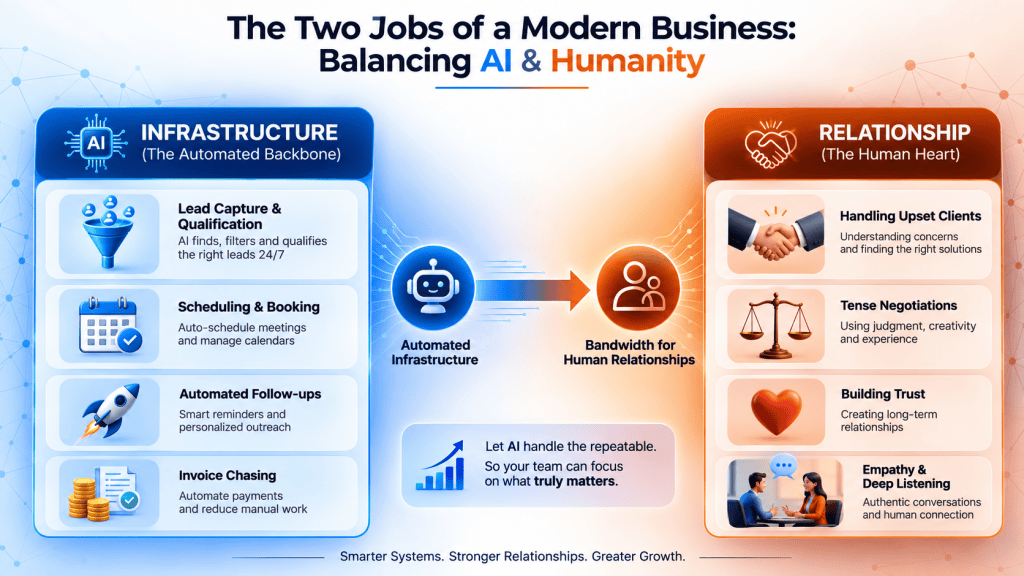
There’s a mistake I see a lot of people make when they first start building an AI-assisted business. I made a version of it myself, early on. You get a taste of how much automation can take off your plate, and it starts feeling like the goal is to automate as much as humanly possible. More automation, less work, right?
Except business isn’t actually one job. It’s two very different jobs wearing the same trench coat. One job is infrastructure: the repeatable, predictable, expectation-setting stuff. Following up on a lead. Confirming a booking. Answering the fortieth “what are your prices” message this month. Chasing a late invoice. That job doesn’t need a human heartbeat behind it, it needs consistency, speed, and to never get tired or forget. That’s exactly what AI is good at, and building it out is genuinely one of the smartest moves you can make for your time.
The second job is relationship. Picture the upset client, or the tense negotiation where someone’s testing whether you’ll hold your price or fold. Or picture the quiet moment a customer decides whether they actually trust you. That job needs an actual person paying real attention. People can tell the difference between a genuine response and a well-disguised template, especially when they’re already upset and looking for a reason to feel more justified in that feeling.
Where an AI-Assisted Business Goes Wrong
The businesses that get this wrong usually pick a side entirely. Either they refuse to automate anything and burn out doing repetitive work a tool could’ve handled in the background, or they lean too hard into automation and apply it to moments that needed a human instead, an automated “we’re sorry for the inconvenience” reply to someone who’s genuinely upset, which almost always makes things worse, not better. It doesn’t feel like an apology. It feels like someone just handling you instead of hearing you.
I’ve made this exact mistake myself, if I’m honest. Early on, I set up a soft auto-reply for anything that sounded like a complaint, something like “we hear you, we’re on it,” just to buy a little time before I could respond properly. It backfired almost immediately. An already-annoyed customer got an instant, obviously templated reply and felt more brushed off, not less. I switched it off within the week and went back to just replying myself, slower, but actually there. That one small failure taught me more about where the line sits than any success ever did.
What Automating Infrastructure Buys Your AI-Assisted Business

The point of building out all that automated backbone, the WhatsApp flows, the lead capture, the scheduling links, isn’t really about saving time in the abstract. It’s about buying back your attention for the moments that actually need it. Every routine task you hand off to a well-built system is one less thing pulling your focus away from the conversation that’s actually going to make or break the relationship.
That’s the real reframe I’d want anyone reading this to sit with. It’s not automate everything so you work less. It’s automate the predictable so you have the bandwidth to be fully present for the unpredictable. The unpredictable moments, the upset client, the make-or-break negotiation, the customer deciding whether to trust you again, are the ones that actually determine whether your business survives. No tool is coming to save you in those moments. Only you are.
AI-Assisted Business: Balancing Automation and Human Touch, Day to Day
On an ordinary Tuesday, this philosophy doesn’t look like some grand strategic decision, it looks almost boring. A lead fills out a form at 7am before I’m even awake, gets an instant WhatsApp reply, and lands in my CRM, ready for follow-up. A returning client gets a scheduling link instead of an email chain. None of that involved me, and none of it needed to.
Then, later that same morning, a different message comes in. This one’s from a client quietly frustrated about a change in scope, the kind of thing that could easily spiral without careful handling. That one I write myself, slowly, reading it twice before I hit send. Running an AI-assisted business well means actually balancing automation and human touch in real time. It means knowing exactly which of those two messages needs speed and which one needs a person actually thinking it through. Most days it’s a mix of both, and the actual skill isn’t picking one over the other, it’s telling them apart quickly enough to respond to each the right way.
If You’re Building Something of Your Own Right Now
I don’t say any of this from some distant, expert-on-a-stage place. I’m building this alongside you, mostly by getting things wrong first and adjusting. But if there’s one thing I’d want you to walk away with, it’s this: don’t measure your automation by how little you have to do. Measure it by how much more present you get to be for the parts of your business that actually need you in the room.

That’s the whole philosophy behind everything I build. Maybe it’s an after-hours system that captures a lead without pretending to be a real conversation. Maybe it’s a content workflow that gets the boring first draft out of the way so I can put my actual voice into what matters. AI runs the infrastructure. I show up for the people. That’s the entire shape of an AI-assisted business balancing automation and human touch, not some elaborate framework, just a constant, deliberate choice about where the machine’s job ends and the person’s job begins. And I think that’s going to be the quiet dividing line between the businesses that feel human in five years and the ones that don’t. It won’t come down to how much AI they used, but how carefully they decided where it belonged.
If you’re somewhere in the middle of figuring that out for your own business, I’d like this to be one of the places you keep coming back to while you work it out. I’m not further along because I have it all solved. I’m further along because I’ve already made a few of the mistakes so you don’t have to.
If you’re ready to start building an AI-assisted business that balances automated efficiency with genuine human connection, I can help. Explore my AI automation services to see how we can streamline your infrastructure without losing the personal touch that makes your brand stand out.