
A local bakery owner once messaged us convinced her website was broken. Her on-page SEO was solid clean titles, tidy headers, fast load times, the works. She’d done everything right on her own site. And yet a bakery two neighborhoods over, with a clunkier website and thinner content, kept beating her to the top of search results.
Nothing was broken. She just hadn’t built anything outside her website yet.
That’s the part on-page SEO can’t cover on its own. You can polish every headline and header tag until the page is flawless, but Google still wants a second opinion. It wants to know what the rest of the internet thinks of you. That’s off-page SEO — and it’s less about your website and more about your reputation everywhere else.
What Off-Page SEO Actually Means
On-page SEO is everything you control directly: your titles, your content, your structure. Off-page SEO is everything that happens elsewhere other websites linking to you, other people mentioning your business, other platforms vouching for you. You don’t fully control it. You influence it.
Think of it the way you’d think about a new restaurant in town. You could have the best menu in the city, but if nobody’s talking about it, no reviews exist, and no other local guide has mentioned it, most people will never trust it enough to walk in. Off-page SEO is the internet’s version of word of mouth. Google is just listening in.
Backlinks: Still the Backbone of Off-Page SEO
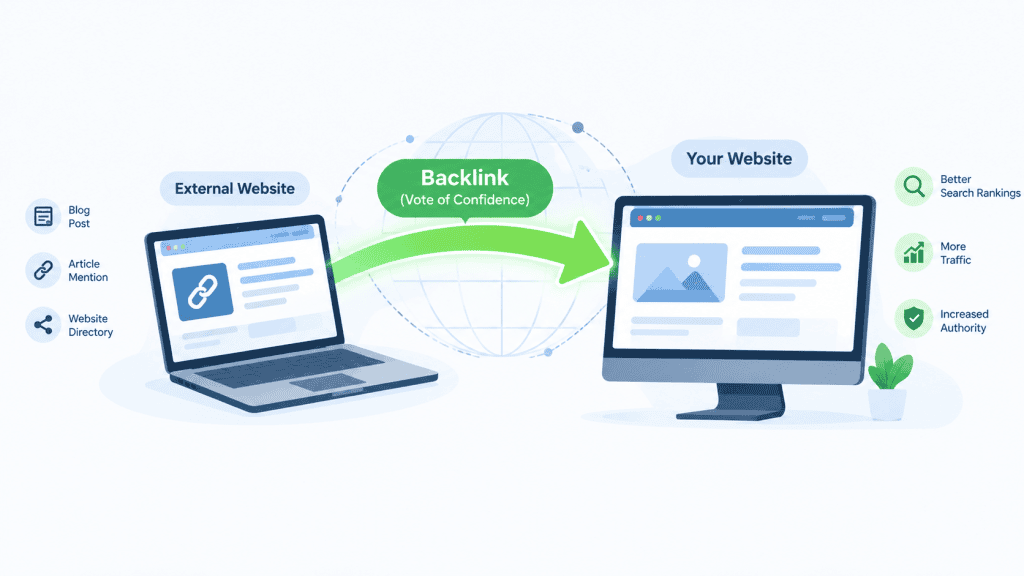
A backlink is simply another website linking to yours. That’s it. But the way Google reads those links is more nuanced than people expect.
Every backlink acts like a small vote of confidence. If a respected site links to your page, Google treats that as a signal that your content is worth trusting. Get enough of those votes from the right sources, and your page starts to outrank competitors who never bothered collecting any.
Here’s where people go wrong, though. Not all votes count the same.
Relevance matters more than raw volume. A single link from a well-known site in your actual industry is worth more than fifty links from random, unrelated blogs. A plumbing company getting linked from a home improvement publication is a natural, believable connection. The same company getting linked from a gaming forum is not and Google notices the mismatch.
Authority matters too. A link from a site Google already trusts carries more weight than one from a brand-new domain nobody’s heard of. This is often measured loosely as “domain authority,” though Google itself doesn’t publish an exact number. The general idea holds up: established, respected sites pass along more credibility than obscure ones.
Anchor text is the clickable words themselves. If a home decor blog links to you using the phrase “affordable custom curtains” instead of just “click here,” that tells Google more about what your page is actually about. Natural, descriptive anchor text helps. Anchor text that’s obviously stuffed with keywords tends to raise flags instead.
Do-follow v/s no-follow is a technical distinction worth knowing. Do-follow links pass on ranking value. No-follow links, common on social media and some directories, technically don’t pass the same SEO weight, though they still drive real traffic and visibility. A healthy backlink profile usually has a natural mix of both, because that’s what a normal, organically-grown website actually looks like.
Earning Backlinks Without Buying Them
Buying links used to be common practice. It isn’t anymore, or at least it shouldn’t be Google has gotten much better at spotting patterns of paid, unnatural links, and the penalty for getting caught can undo months of legitimate progress. The businesses that build real authority tend to earn links instead of shortcut their way to them.
Create something worth linking to. This sounds obvious, but it’s the part most businesses skip. A genuinely useful guide, an original bit of research, a tool, a local resource nobody else has bothered to make these are the things other sites actually want to reference. Nobody links to a generic “welcome to our website” page. People link to things that solve a problem.
Get listed in relevant directories. Industry-specific directories, local chamber of commerce sites, and niche listing platforms are some of the easiest legitimate backlinks available. They’re not glamorous, but they’re real, relevant, and low-effort to collect.
Build relationships with people in your industry. Guest posts, collaborations, interviews, and being quoted as a source in someone else’s article all come from actual relationships, not cold requests. A short, genuine conversation with another business owner or local journalist often does more than a mass email blast ever will.
Get local press when you can. A feature in a local news outlet, a “best of the neighborhood” roundup, or a mention in a community newsletter all count as backlinks and they tend to come from sites with real authority in their region.
Authority Isn’t Just About Links
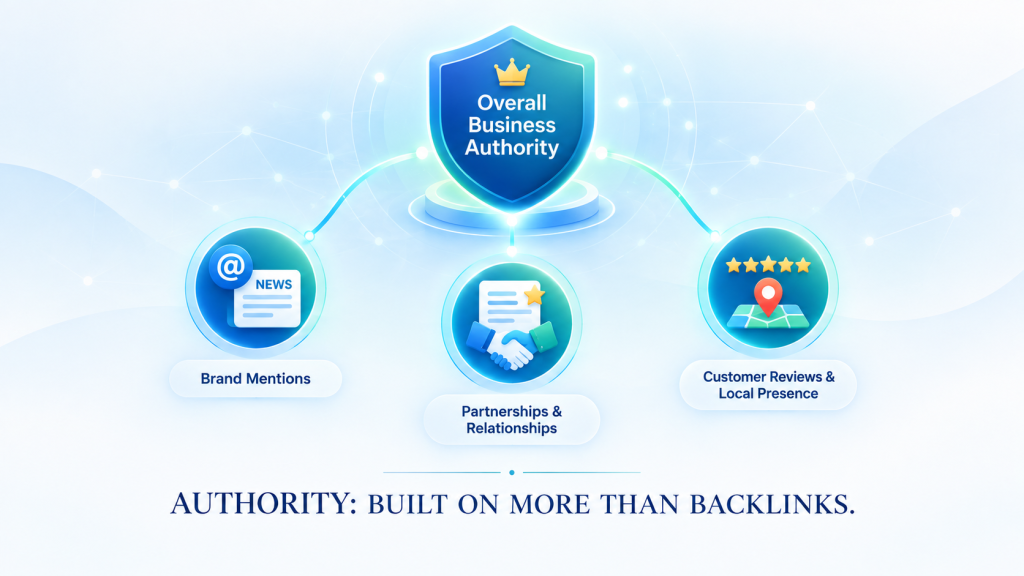
Backlinks are the most talked-about part of off-page SEO, but they’re not the whole picture. Google is increasingly trying to answer a broader question: is this a real, trustworthy business, or not?
Brand mentions count, even without a link. If a respected site mentions your business by name even without linking to you that still registers as a signal. Google can connect the dots between your brand name showing up across the web and treat it as a form of validation, separate from a direct link.
Social signals play a supporting role. Shares, engagement, and consistent activity on social platforms don’t directly boost rankings the way backlinks do. But they do influence how much traffic and attention a piece of content gets, which in turn increases its odds of earning real backlinks. It’s an indirect chain, but a real one.
Reviews are an off-page trust signal too. This overlaps heavily with local SEO, but it’s worth repeating here: a steady stream of genuine reviews across Google, Yelp, and industry-specific platforms tells search engines and real customers that your business is active, legitimate, and worth choosing.
The Trust Signals Nobody Talks About
Beyond links and mentions, Google is also quietly reading a handful of subtler signals when it decides how much to trust a business.
Consistency across the web matters. If your business name, contact details, and general information line up across every platform you appear on, that consistency reads as legitimacy. Mismatched details, on the other hand, create the kind of confusion that erodes trust for search engines and for actual people trying to reach you.
Domain age and history carry some weight. A domain that’s existed for years, with a steady history of content and activity, generally earns more trust than a brand-new one. This isn’t something you can rush, but it’s a reminder that off-page SEO rewards patience as much as effort.
Unnatural link patterns get penalized, not ignored. A sudden spike of hundreds of backlinks appearing overnight looks suspicious, not impressive. Google’s algorithms are built to spot patterns that don’t match how real authority is normally earned gradually, from a mix of sources, over time.
Mistakes That Quietly Undermine Off-Page SEO
A few habits sabotage what would otherwise be solid progress.
Chasing quantity over quality. A hundred weak, irrelevant backlinks won’t outperform ten strong, relevant ones. If anything, a pile of low-quality links can actively hurt more than help.
Ignoring no-follow opportunities. Some businesses skip directories or social platforms because the links are technically no-follow. That overlooks the actual traffic, visibility, and brand consistency those links still provide.
Letting your online reputation go unmanaged. Off-page SEO isn’t just about links. Unanswered reviews, inconsistent business details across platforms, or a brand that never gets mentioned anywhere quietly signals inactivity, even to businesses that are actually thriving.
Expecting instant results. Off-page SEO compounds slowly. A single guest post or one new directory listing won’t move rankings overnight. The businesses that see real results are the ones treating it as an ongoing habit, not a one-time project.
Off-Page and On-Page SEO Work as a Pair
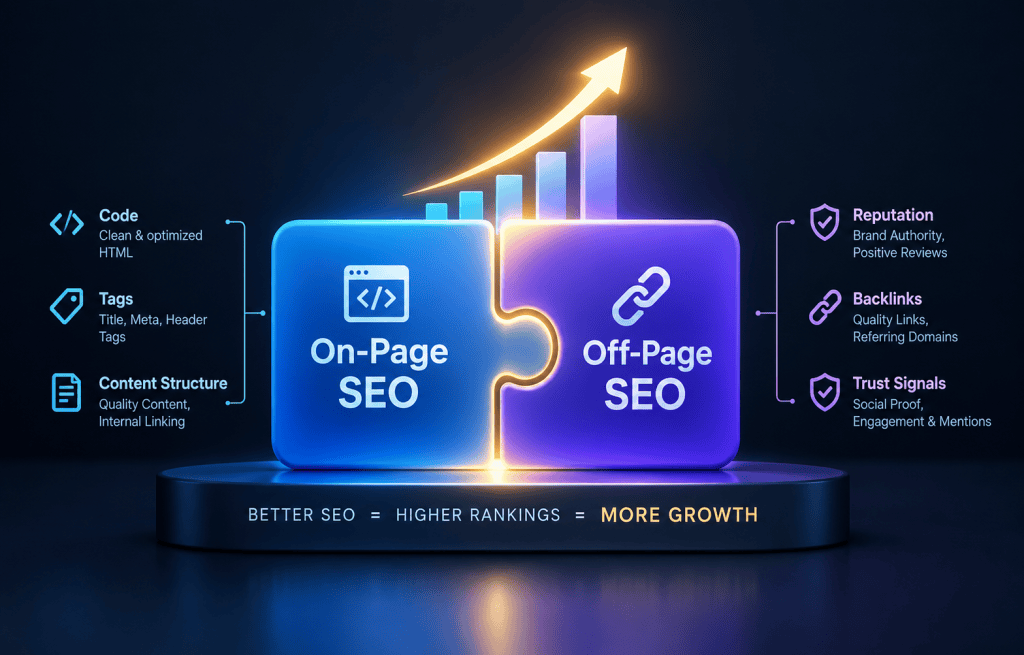
On-page SEO gives Google a clear, well-structured page to evaluate. Off-page SEO gives Google a reason to trust that page in the first place. Neither one substitutes for the other. A beautifully structured page with zero outside credibility will struggle just as much as a highly trusted brand with a confusing, poorly built website.
That bakery owner didn’t need to rebuild her site. She needed the rest of the internet to start vouching for her a mention from a local food blogger, a handful of genuine reviews, a listing in her city’s small business directory. None of it happened overnight. But piece by piece, the outside world started backing up what she already knew: her bakery was worth finding.
That’s really what off-page SEO comes down to. It’s not a trick, and it’s not something you can fake convincingly for long. It’s the slow, steady process of earning a reputation the same way you’d earn one in real life until Google, and everyone searching, starts to agree.
Want help building real authority instead of chasing shortcuts? Check out our SEO services.